
DAVID GILBERT WRIGHT
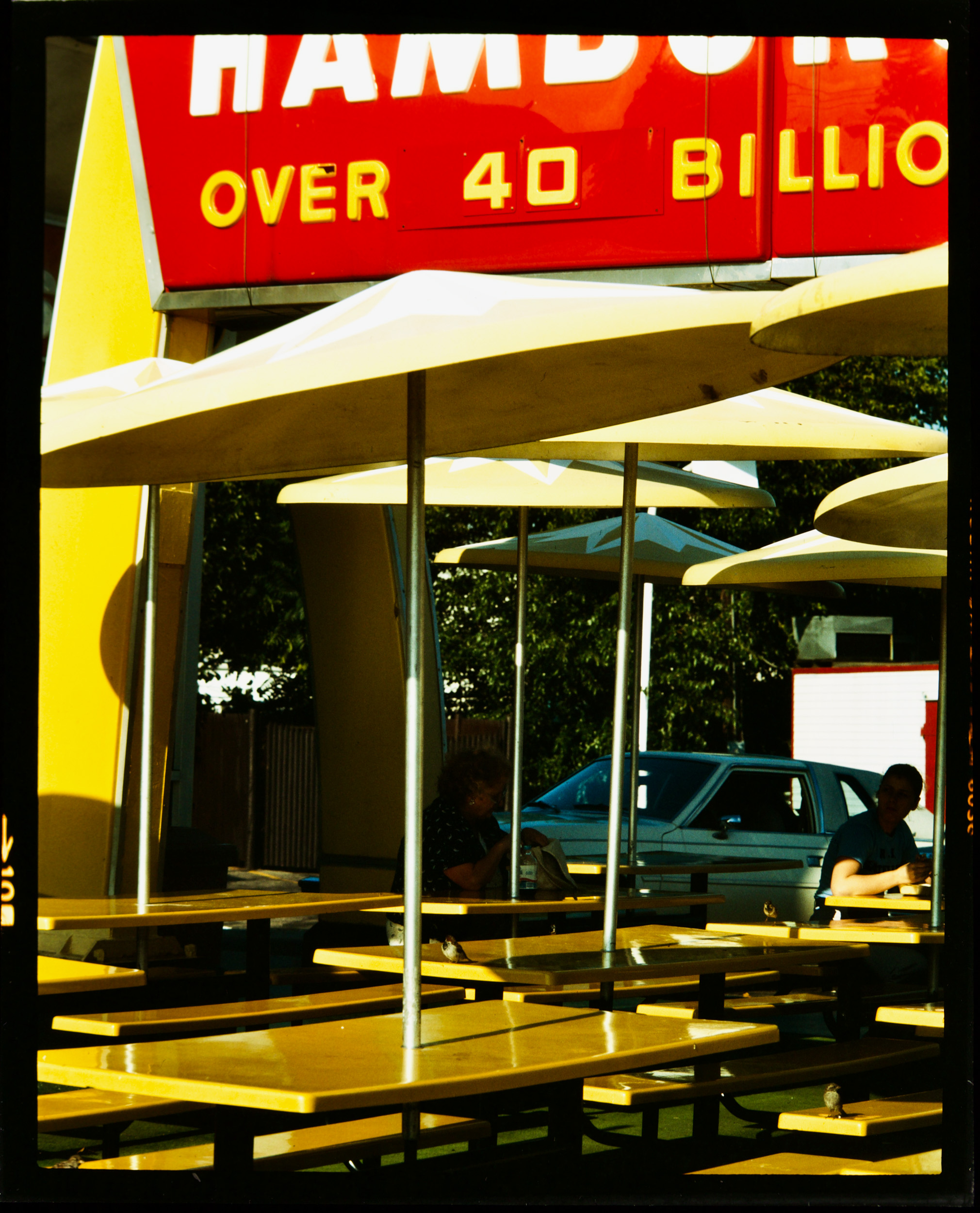
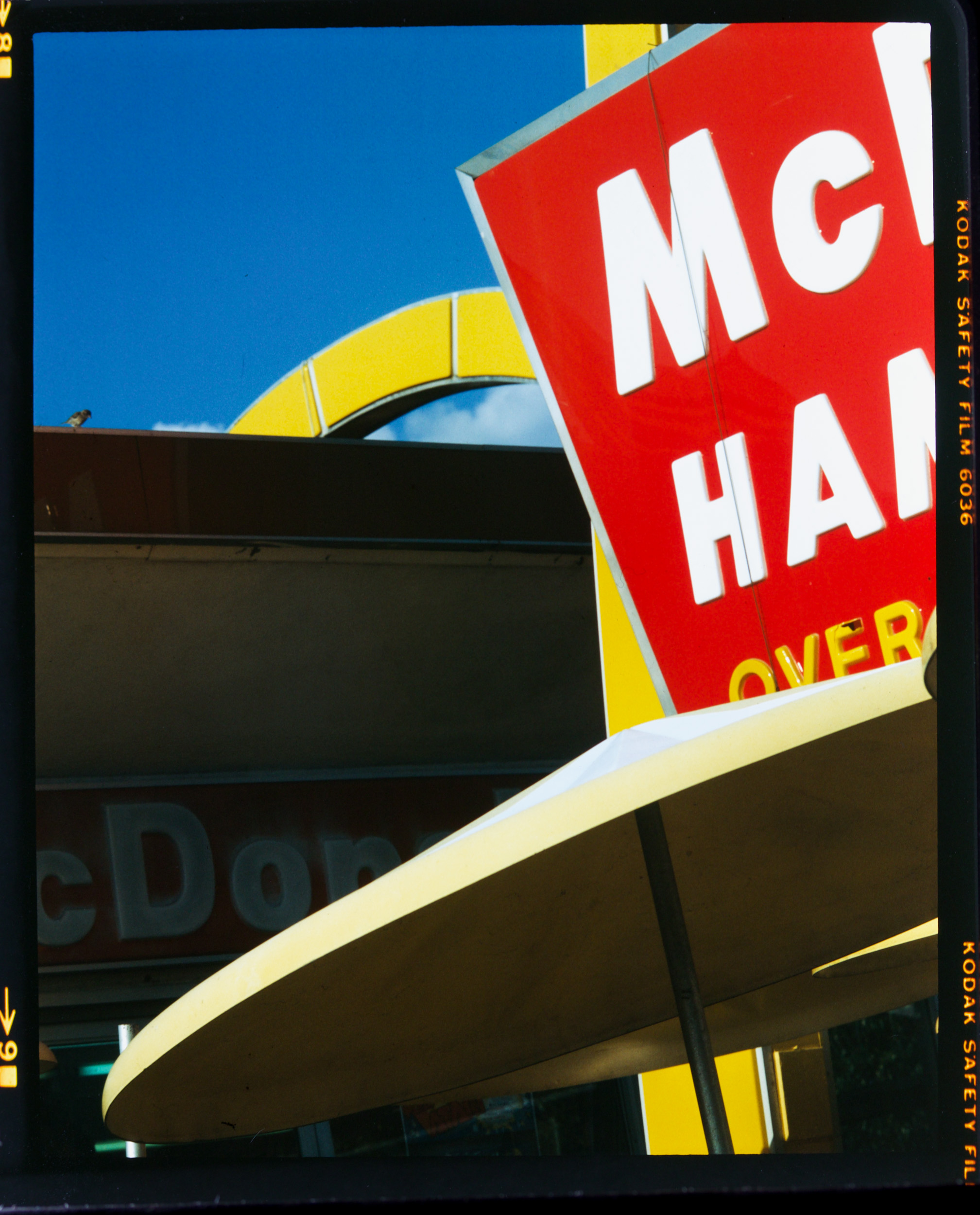
// David has been in photography for nearly 50 years. He specialises in documentary photography and works on long-term projects. We have featured his black and white work, but recently discovered his analogue colour photography. He shared a series of semi-abstract takes on that well-known fast food chain, McDonald´s, taken on a USA road trip in the 1980s, in which he explored his concept of “paintbox reality”.
“Mere coloUr, unspoiled by meaning, and unallied with definite form, can speak to the soul in a thousand different ways. ”
Oscar Wilde
David Gilbert Wright studied at the London College of Printing, worked professionally in commercial, wedding, medical and government photography and has lectured in photography for many years. He has consciously never made the transition to a digital workflow, preferring the craftwork of the analogue process.
He has spent most of his life working on long-term projects, often in very immersive ways. Examples include his series about the rural, west coast of Ireland shot during the 1980s and 90s, The English Way of Death, and In Search of Christianity.
David is also the editor the f8documentary magazine.
What draws you to the arts?
“Creativity is what singles us out from the rest of the animal kingdom. Art in all its manifestations is a creative occupation. It enables us to express ideas and views about our world that ultimately lead to greater understanding. I have always been a creative person. I originally went to art college with the intention of studying painting. While there, I discovered photography and found it to be an ideal medium to realise my ideas.
I suppose the best way of describing why I enjoy photography is that it is one of the most important aspects of my life. It has been the thing I think about ever since I was a teenager. There is a magic in making photographs. I think about projects, pictures and ideas every day. I am grateful for discovering photography because it has helped me through some very difficult times. To be creative is a wonderful feeling.”
What do you like best about this series?
“The contrast between the primary and secondary pallettes.”
These pictures were made while on a trip to the USA in the 1980s. David was working on an idea he calls “Paintbox Reality”. It is an attempt to see broad canvases of colour in the world. David told us his story about his abstract colour series of this well-known fast food chain.
I think it must have been in 1983 that I first went to America. It was the summer. I stayed for around 6 weeks. The aim was to photograph mainly landscapes in colour. However, my brother-in-law George mentioned this old McDonald’s nearby to where he lived. He thought I might find it interesting. I had been working on the Paintbox Reality project on and off for about 4 years.
The McDonald brothers, Richard and Maurice began with one restaurant in San Bernardino, California. It was originally a drive-thru barbeque restaurant cooking the food to order. They came up with the idea of only offering burgers, fries and milkshakes. Selling them at half the price of their competitors. Doing away with table service by customers collecting their orders from a seperate window. And serving the food in paper bags so as not to have crockery and cutlery. The waiting time was vastly reduced by cooking the food in advance and keeping it warm. This model proved to be an overnight sensation and you will recognise aspects of it as the modern McDonald’s experience.
In April 1952, they decided they needed a new building in order to improve the efficiency of the food production and be more visible to prospective customers. After interviewing four architects they went with a local – Stanley Clark Meston. Together, they came up with a completely new image consisting of two enormous golden arches made of sheet metal that towered 25 feet and straddled the building. The walls were covered with red and white rectangular tiles with stainless steel prep counters and large pane glass windows giving a light clean appearance. The restaurant had a red, white, yellow and green neon sign over the roof and at the roadside was a smaller but no less imposing Golden Arch sign with a cartoon chef called Speedee striding over it. This new restaurant was to become the basis of the McDonald brother’s fast-food brand.
When I saw the old McDonald´s restaurant I knew it was something special. I shot 2 or 3 rolls of Ektachrome E6 120 film using my Pentax 6×7. I knew at the time I had some stunning semi abstract pictures. When I got home and put them into the lab I was hardly able to wait. Seeing the rich colours got me really excited about them. One of the really classy monthly photography mags did a feature on me and used some of them. I also exhibited the series a few times in the 80s and 90s.
Photographs are abstracts of the world. They translate reality into a slice of time; a two-dimensional plane; a narrowed view of approximately 80 degrees or less, and a depth of field dependant upon the point of focus. They may even abstract from the visible spectrum to monochrome. Building on my Gestalt project, this series moved away from being completely out of focus to being completely in focus. Colours moved from the subtle to almost pure blocks. I framed in search of designs rather than subjects. The purpose was to produce unashamedly colourful photographs in a painterly style from the real world. The result could be described as a form of ‘paint-box reality’.
In 1974, the first McDonald’s opened in England in Woolwich. It was the 3000th to open. I remember the milkshakes. I had never had anything like it. The special raspberry one was my favourite. Since then, the McDonald’s corporation has become an international phenomenon. They are one of the biggest employers worldwide however, the low pay and sometimes poor shift managers has led to disgruntled staff. Since showing this story a number have written to me about the poor conditions, stressful work environment, bullish line management and customer treatment. Like any workplace, McDonald’s has its problems but even so, it soldiers on through pandemics, economic slumps, wars and climate-change pressures.
Click on the photos to see the full image.




All photos © David Gilbert Wright
To see more of his photography visit David´s Instagram page.
 SPECTACULUM MAGAZINE